
Agent Skills is an open standard that lets AI assistants use specialised knowledge and workflows. According to Anthropic’s introduction, a skill is a folder containing written instructions in a file named SKILL.md, with optional reference material or scripts. It gives teams a way to provide AI tools that support the standard with instructions on how a particular job should be done.
For beginners, think of it as a work manual stored together with its attachments. For example, when asking AI to organise a handover document, you can provide meeting notes and specify which items must be retained, how to handle insufficient information, and what to check afterwards. Whether these instructions produce a useful result still needs to be checked through actual tasks.
First, distinguish information, methods and scripts
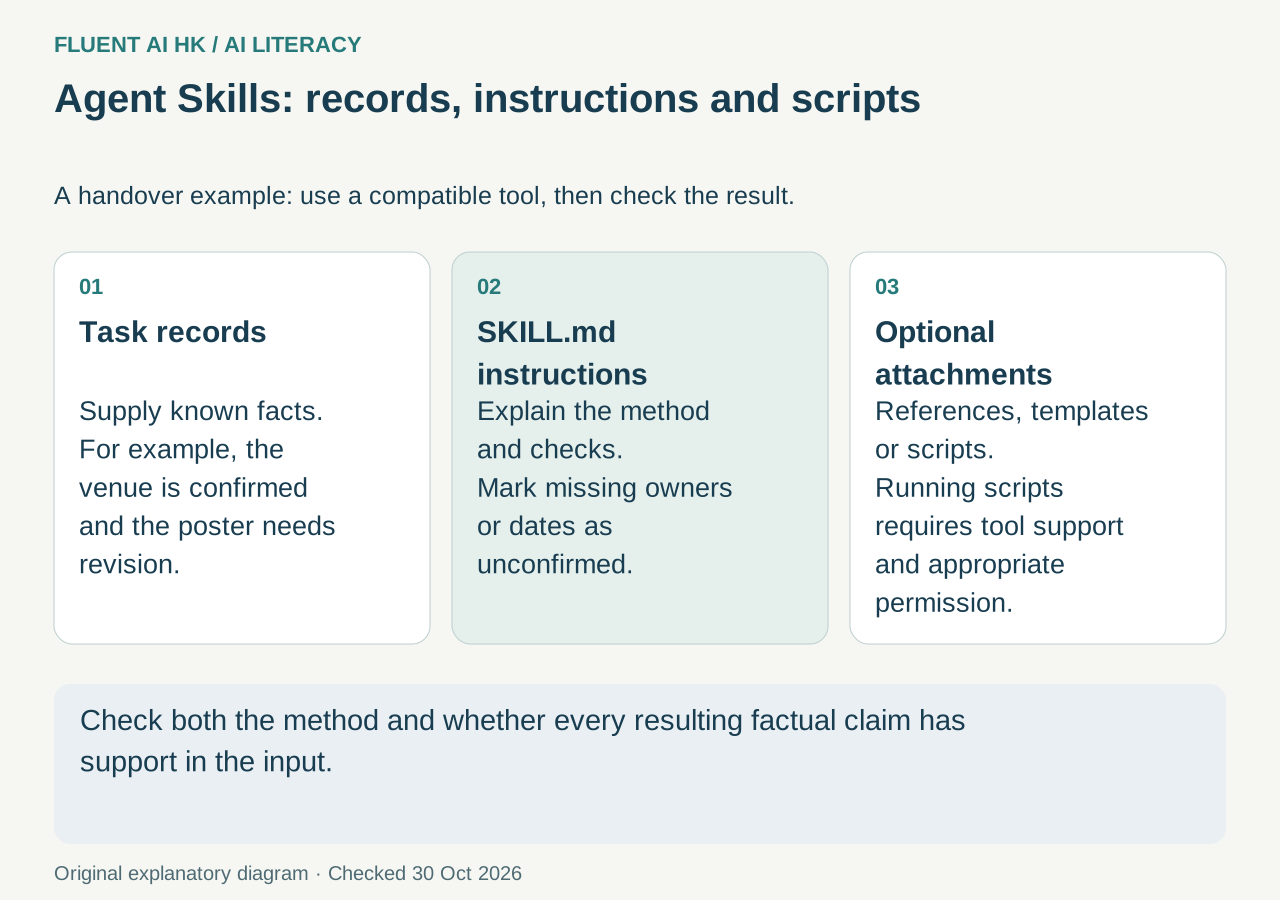
Reference material answers “What information is already known?” Work instructions answer “How should it be handled?” For example, an event record lists the venue and date, while handover instructions ask AI to separate confirmed arrangements, unresolved matters and the people responsible. Using both makes the task easier to define.
An accompanying script is another component. It can provide a specific way to process the work, but whether it can actually run depends on the tool and environment being used. The official explanation that a folder can contain scripts does not establish that every skill can access the internet, modify files or operate other services.
This distinction also helps when reading about different capabilities in product introductions. Google’s introduction to Gemini tools for small businesses separately mentions connecting business applications. When reading, check “Does it have work instructions?” and “Which services can it connect to?” separately. One does not establish the other.
What work could it be used for?
The following are possible applications designed around this structure, rather than results tested for this article:
- Organising handover information: use consistent criteria to separate completed work, unresolved matters and next steps. This requires sufficient original records.
- Rewriting training materials for new staff: use a glossary to turn internal terminology into language beginners can understand. Someone needs to check that the explanations preserve the original meaning.
- Checking event documents: identify missing dates, locations or contact arrangements against defined requirements. You first need to specify which fields are required.
These uses share two conditions: a clear scope and completion criteria that can be checked. “Organise it better” is difficult to assess. “Keep the original source for every unresolved matter, and mark the person responsible as awaiting confirmation if none is given” is easier to judge.
Practise with a handover record
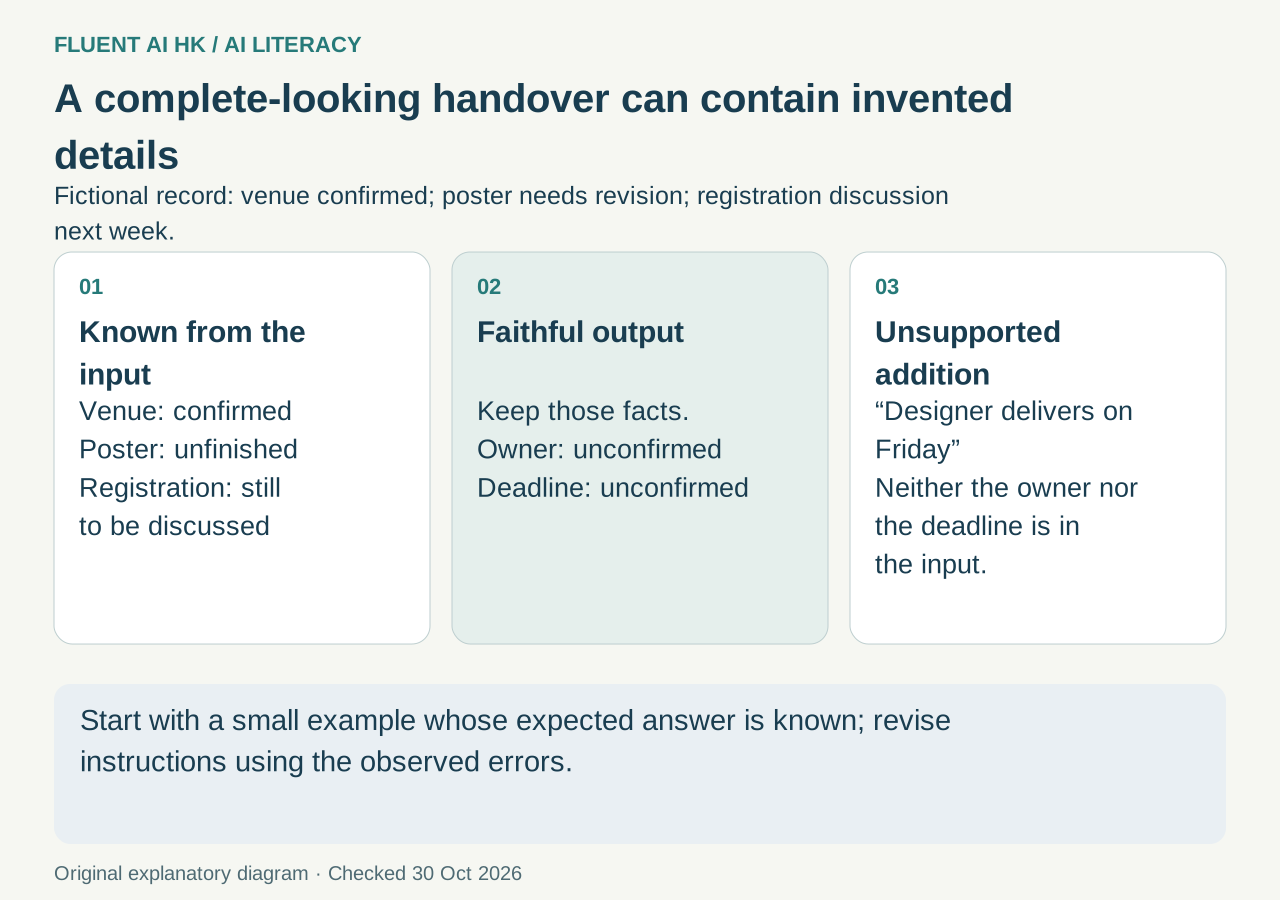
The example record reads: “The venue is confirmed. The promotional graphic still needs revision. Registration arrangements will be discussed next week.” If the aim is to organise a handover document, you can first ask for the confirmed facts in the original to be retained, followed by a list of missing information.
A suitable result should retain “The venue is confirmed” and indicate that the promotional graphic is unfinished and registration arrangements remain undecided. The original does not say who is responsible for the revision or give a definite completion date, so both should remain awaiting confirmation. If AI adds “The designer will deliver the artwork on Friday”, it has introduced unsupported content, even if the document looks tidy.
This example shows that checking a skill’s effectiveness involves two questions: did it categorise the information according to the process, and does the categorised content remain faithful to the source? Consistent formatting answers only part of that.
What does an open standard mean?
In the same announcement, Anthropic says it is donating the Agent Skills standard to the Agentic AI Foundation under the Linux Foundation, with a commitment to openness, community participation and vendor neutrality. The announcement also states that multiple AI platforms have integrated the standard.
This helps us understand its design direction and adoption. Whether the same instructions produce the same results in another tool still requires separate testing. The standard provides a shared way to organise information; the number of platforms adopting it alone cannot tell you that your work will definitely be done correctly.
According to the official Agent Skills specification, SKILL.md begins with YAML fields recording name and description, followed by work instructions in Markdown. Attachment folders such as scripts, references and assets are optional. Beginners can first write down the task, the information that must not be added, and the items to check after completion, then ask someone familiar with the chosen tool to help assemble the folder. This article does not promise that every product has the same import interface or permissions to run scripts. Before installing a skill, consult the product’s documentation and inspect the attachments.
A checking exercise you can do yourself
Using the three sentences in the handover record above, first write your own answer on paper, then check the AI’s result:
- Can you find an original sentence supporting every item marked “confirmed”?
- When a person responsible or a date is missing, is that gap clearly retained?
- Which items are facts from the original, and which are merely suggested next steps?
Next, add the sentence “The administration team is handling the promotional graphic; the completion date is undecided”, and check whether the result updates only the relevant items. This helps you observe whether AI follows changes in the information, rather than simply producing a document that looks complete.
When designing your first skill, choose a small task that is easy for a person to review. Keep the input, the instruction version and a record of errors, then revise the instructions in response to problems. To explore the relationship between work rules and memory further, read our explanation of conversations, memory, rules and fine-tuning.
Article checked on: 30 October 2026. To build a foundation in asking questions and verifying answers, start with our free twelve-chapter AI course.
Join the discussion
CommunitySign in to share an idea or question. Comments appear after review.
Sign in to comment