
Google’s Agent Development Kit (ADK) is a framework developers use to build AI agents. An AI agent can be understood as an AI system that works with tools to handle tasks. ADK provides ways to manage conversations, retrieve past information and control tool actions. It is not a chat product that automatically learns everything once you switch it on.
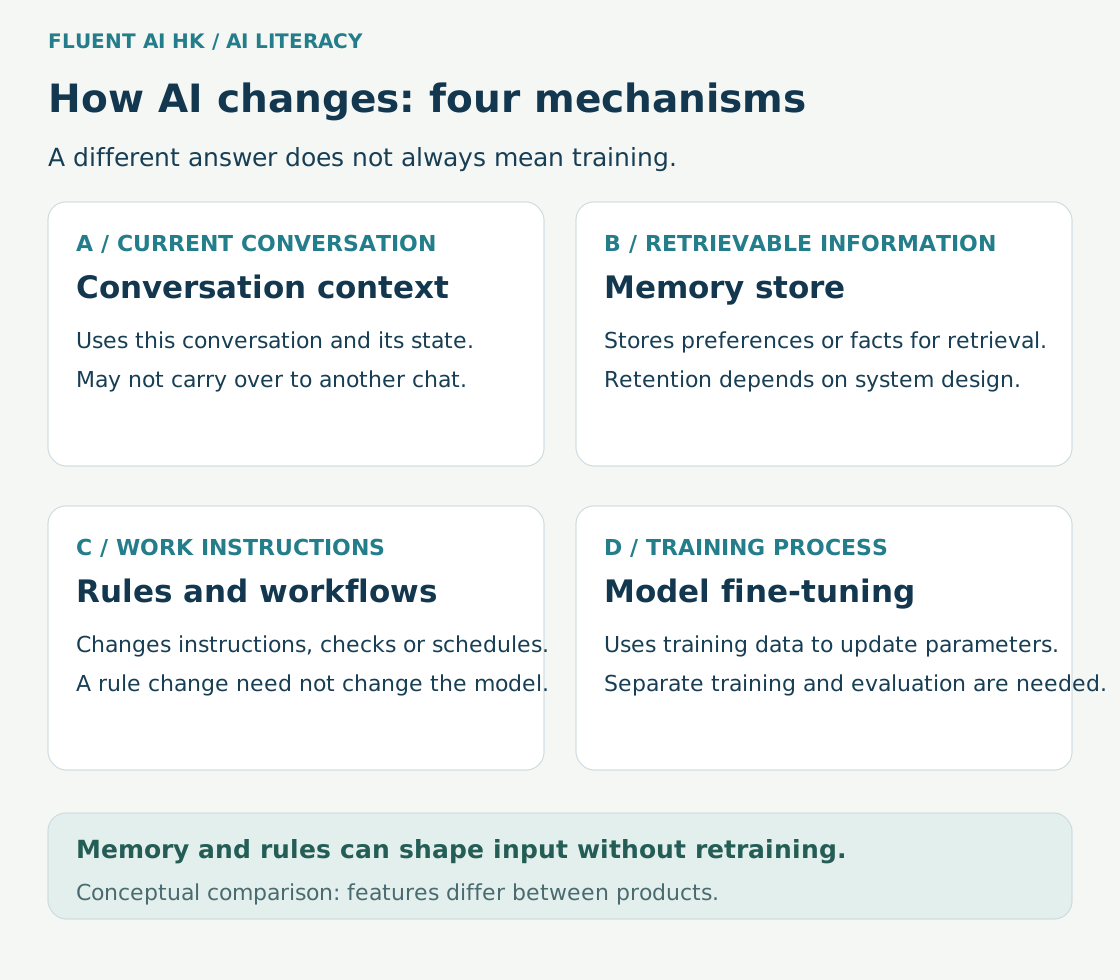
When a tool claims it “understands you better the more you use it”, it may be saving preferences, reading old information or following revised work instructions. This does not necessarily involve training the model. Understanding the following four distinctions helps you know what to expect.
1. The Current Conversation: Knowing What You Just Said
If you first say “Please use Traditional Chinese” and then ask the AI to organise a passage of text, it can use information from that same conversation to respond. In ADK’s Session documentation, a Session represents a single conversation thread, containing messages, records of tool actions and temporary data for that interaction.
This explains “remembering within this chat”. It does not prove that the AI will still remember when you start a new conversation, let alone that the model has been retrained.
2. Long-Term Memory: Retrieving Relevant Information from a Database
ADK’s MemoryService documentation compares memory to a searchable database: the system adds conversation data to memory, then retrieves relevant snippets as needed. For example, the next time it organises a document, it could retrieve a record of your preference for “a summary first, details afterwards”.
This requires the system to have storage and retrieval arrangements in place. “Long-term memory” does not guarantee permanent storage either: ADK’s InMemoryMemoryService loses its data when the program restarts, while other options provide persistent storage. These are differences between implementations within the framework, not rules that apply to every AI product.
3. Rules and Workflows: Changing How Things Are Done
“List missing information before making suggestions” is a work instruction. “Organise the information, then pass it to a person for checking” is a workflow design. Both can change how a system behaves without involving model fine-tuning.
ADK’s safety documentation discusses model instructions, restrictions built into tools, and checks before and after actions separately. The key distinction is this: telling an AI “Do not make payments” is an instruction. Giving the tool no payment permission in the first place is a separate layer of control. Neither can replace the other.
4. Model Fine-Tuning: Adjusting the Model Through Training
Fine-tuning uses training data to adjust a model’s trainable parameters—the numerical settings that affect how it produces responses. It is not simply saving a preference as a record.
A Google Gemma LoRA tutorial marked as deprecated helps explain the distinction: LoRA keeps the original weights unchanged and adds a smaller number of new, trainable weights. Fine-tuning therefore does not necessarily update all the original parameters. We cite only its explanation of the mechanism here, not the old tutorial’s installation steps or account requirements.
Remembering Your Needs Does Not Mean Having Permission to Act
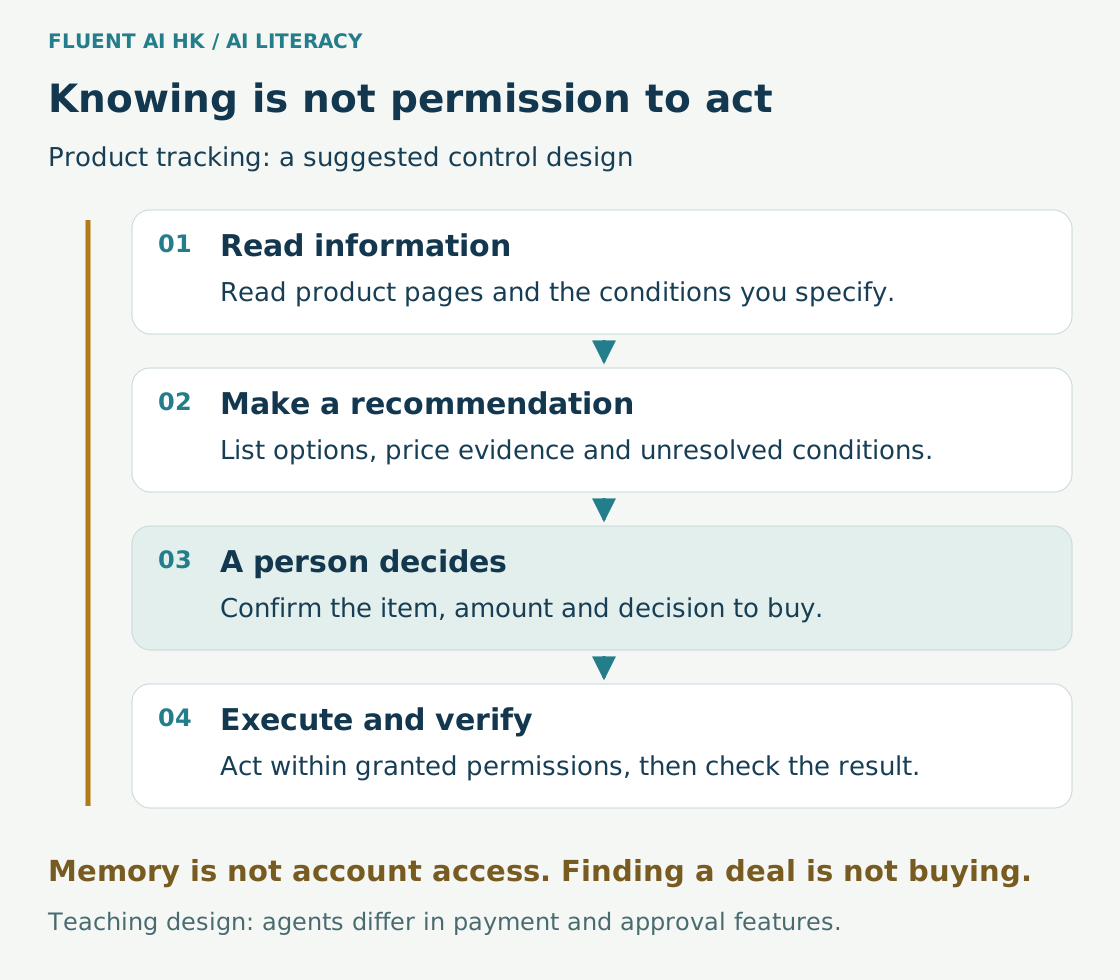
An AI knowing what you want to buy is a different question from whether it can log in to a website, submit an order or make a payment. ADK’s authorization guidance explains that the identity a tool uses must be authorized by the external system. If it has only read-only permission, the tool cannot write data even if the model decides to do so.
The diagram below shows our suggested control design: read information and make suggestions, let a person decide, then act within the granted permissions and check the result. This is not the default behaviour of every agent, nor is it a screenshot of a product interface.
Workplace Example: Organising Event Supply Requirements
For administrative staff preparing event supplies, a system could be designed for three uses. These are illustrative examples, not test results:
- Reuse reading preferences: Save “put the summary first” and use the same structure next time. This requires settings for storage and retrieval across conversations.
- Retrieve previous specifications: Find supply dimensions in event records the system is allowed to read, and include the source of those records. This requires accessible data and retrieval tools.
- Prepare a draft request: Follow the rule “ask first if information is missing” to list quantities, purposes and items awaiting confirmation. This does not grant permission to submit the request or make a purchase.
Even when a record is successfully retrieved, you still need to check whether it remains applicable. Specifications from the previous event may not suit the current one. Memory is reference material, not an automatically correct answer.
A Ten-Minute Exercise: Test What It Actually Remembers
Choose a tool you already have permission to use and that provides documentation for the relevant features. Use only fictional information. First tell it, “For this demo project, the preference is for three-point summaries”, and ask it to organise some text in the same conversation. Then start a new conversation and observe whether it still uses that format. If the product allows you to view or edit its memory, change the preference and try again.
Record four questions: What information did it use? Where did that information come from? Was it updated after you made a change? When relevant information was missing, did it admit that it did not know, or fill in the gaps itself?
One correct answer does not prove that fine-tuning has taken place. Forgetting once does not necessarily mean there is no memory feature either; the information may not have been saved or successfully retrieved. Official documentation saying that a framework “supports” something does not mean a particular product has enabled it.
Learning to distinguish “what it knows”, “how it works” and “what it is allowed to do” is more useful than simply asking whether AI can learn by itself. To keep building the foundations for assessing tools and checking results, start with Fluent AI HK’s free twelve-chapter AI course.
Join the discussion
CommunitySign in to share an idea or question. Comments appear after review.
Sign in to comment